
Your dog used to be a champion napper, the kind that could snooze through a delivery van and a dropped saucepan. Now they’re pacing like they’ve got somewhere to be, glued to your leg, barking at the air, and doing that wide-eyed “on alert” stare that makes your own nervous system spike.
If that’s you, you’re not alone. The phrase “emf and the anxious dog” keeps popping up for a reason. Modern homes are packed with signals, chargers, smart gadgets, and cables, and plenty of owners are wondering if it’s part of the puzzle.
The goal here isn’t to “prove” your router and mobile phone are the villain. It’s to help your dog feel safer and more settled, using a calm, practical process. We’ll start with the obvious; health, routine, triggers, then look at potential EMF patterns.
What anxiety can look like at home: the signs owners keep reporting
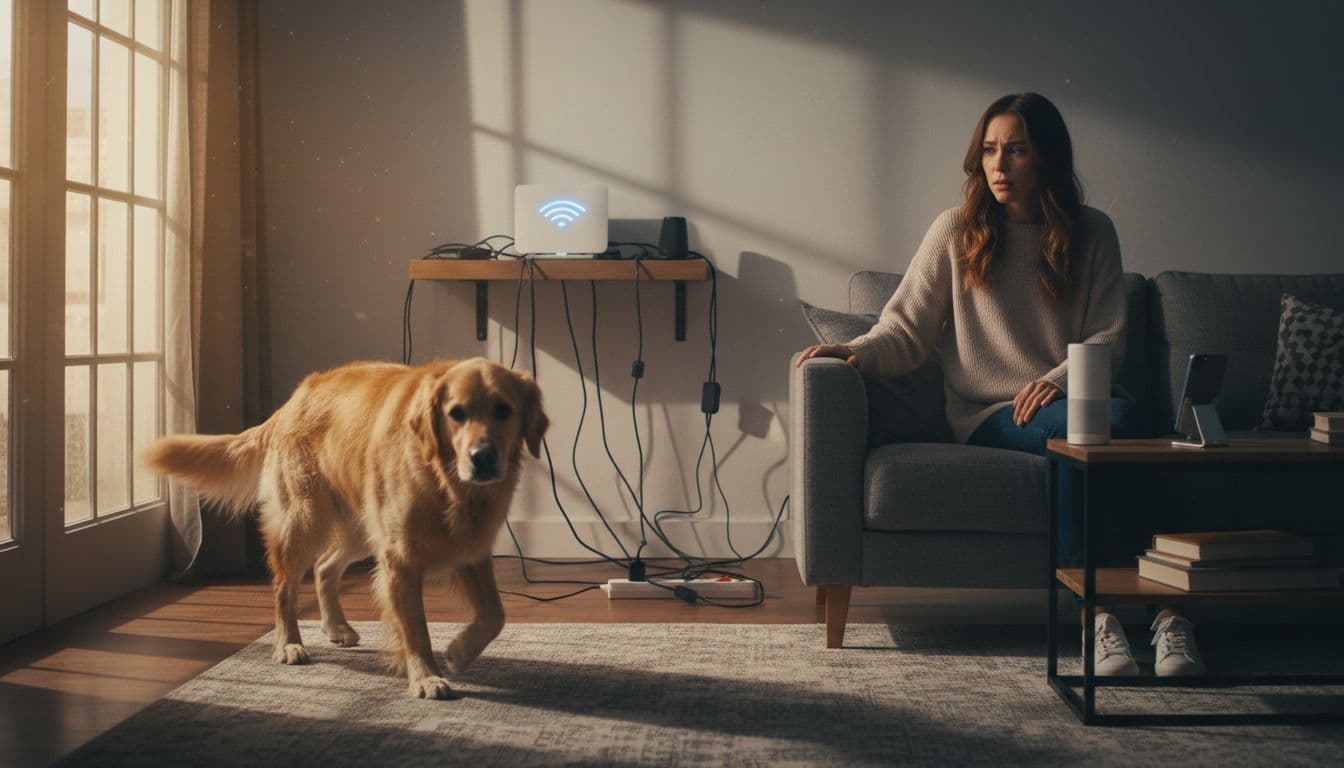
Anxiety isn’t “bad behaviour”. It’s communication. Your dog’s nervous system is saying, “I don’t feel right”, and the outward signs are often the same ones owners describe again and again: pacing, clinginess, jumpiness, trouble settling, and sudden reactivity.
A quick safety note. If your dog shows a sudden, dramatic change, or you notice anything that looks like pain or a neurological issue, treat it as urgent and speak to a vet. That includes:
- Collapse, seizures, or fainting
- Refusing food and water, or repeated vomiting
- Pain signals (yelping, hunched posture, guarding, sudden aggression when touched)
- Extreme aggression that’s out of character
For everything else, think of these behaviours as clues. The best outcomes come from treating it like a detective story, not a blame game.
Pacing and restlessness: when your dog cannot switch off
Pacing anxiety often looks like loops around the sofa, constant getting up and down, or wandering from room to room like they’re patrolling a perimeter. Some dogs “scan”, staring at doorways and windows, ears flicking at every tiny sound. Night-time can be the worst, with restless wandering that breaks everyone’s sleep.
Owners often notice patterns: it’s worse in the evening, it happens mostly in one room, or it spikes when the house is busy and devices are on charge. Don’t overthink it, just track it. Jot down: time of day, where it happened, what was going on (TV on, cooking, visitors), and how long it lasted.
Clinginess and reassurance-seeking: ‘Velcro dog’ behaviour that feels new
Clinginess becomes a problem when it’s intense and new. Shadowing you from room to room, leaning hard into your legs, pawing, whining, needing constant contact to settle, panicking when you step into the loo for 30 seconds.
In the moment, keep your response boring and kind. Calm voice, predictable routine, no scolding, and offer a consistent settle spot (bed, mat, crate if they love it). You’re aiming for safety, not a showdown.
Reactivity and jumpiness: barking, lunging, and a shorter fuse
Reactivity is an over-response to a trigger. A normal noise becomes a full-body alarm. A person walking past the window becomes a bark-fest. Another dog on a lead gets a lunge.
A useful concept is stress stacking. Little stressors pile up, and then one tiny thing tips them over. Owners often report dogs being more reactive near windows, after a busy evening at home, or when there’s constant background noise and movement. If you plan to work with a professional, take short video clips. They’re gold for a vet or reward-based trainer.
Before you blame the WiFi: the most common non-EMF causes to check quickly

Before you start moving furniture and switching off Wi-Fi, do the fast checks that catch a huge chunk of cases. Not because EMF can’t play a part, but because anxiety signs overlap with pain, discomfort, and plain old life stress.
If pacing, clinginess, or reactivity is new, the cleanest order is: health first, then routine and triggers, then the more subtle environment stuff (including EMFs). If you want a broader anxiety toolkit alongside what you read here, how to calm anxious dogs naturally is a solid companion piece.
Health, pain, and itching: anxiety lookalikes that are easy to miss
Pain is sneaky. Dogs don’t always limp or cry. They pace. They can’t settle. They snap when approached. They follow you because you’re their safe place.
Common culprits include joint pain, dental pain, tummy issues, UTIs, allergies, ear infections, and hormone shifts. Watch for clue clusters, not single signs:
- Licking or chewing paws, legs, or flanks
- Panting at rest, or trembling when it’s not cold
- Stiffness after sleep, reluctance to jump or climb
- Hiding more than usual, or guarding a spot
- Appetite changes, toilet changes, or disturbed sleep
If symptoms are escalating, book the vet. A basic exam and history can rule out a lot, and it keeps you from chasing ghosts.
Routine changes, unmet needs, and trigger stacking
Dogs are routines with fur. Change the schedule, add building works, bring home a baby, lose a family member, move house, even switch walking routes, and some dogs wobble.
Then there are unmet needs: not enough sleep, not enough sniffing, not enough chewing, too much screen-and-chaos in the evenings, no calm alone-time practice. Stress stacking fits here too. One loud day can make the next day’s “small” trigger feel massive.
Try a 7-day reset that’s simple enough to stick to:
- Protect sleep: more quiet hours, fewer late-night exciters.
- Add decompression: a slower sniff-walk, not a cardio march.
- Reduce chaos peaks: calmer greetings, predictable feeding and rest.
If your dog settles with these changes, you’ve learned something important, and you didn’t need to touch the router.
So where does EMF fit in: what it is, why some dogs may be sensitive, and what the research says so far

EMF, electromagnetic fields, is a broad label for the fields and signals produced by power cables, routers, phones, smart devices, and all the “always on” kit in a modern home. Some exposure is unavoidable. The open question is whether certain dogs, in certain homes, under certain stress loads, cope worse.
As of February 2026, there still isn’t strong, direct research linking everyday home EMF exposure to dog anxiety in a neat cause-and-effect way. The evidence base is still developing. There are, though, animal studies showing that some EMF exposures can shift stress-related biology and behaviour (in lab settings that don’t perfectly match real homes). For a taste of that research trail, see this multi-frequency radiation anxiety study in mice, and this paper on 50 Hz field effects on a key arousal system in rats.
What does that mean for your dog? It means you can be open-minded without going full tinfoil. Track patterns, test changes, and keep the basics (health, routine, training) running in parallel.
Everyday EMFs vs therapeutic frequencies: do not mix them up
This is where people get tangled. Background EMFs are uninvited exposure. Therapeutic frequency approaches are intentional, controlled, and designed to support the body’s own regulation.
A simple analogy: think of your dog like a guitar. Random noise can be irritating. A clean tuning note can help bring things back into harmony. Bodies also generate measurable electromagnetic activity, including the heart’s field, and external frequencies can interact with biological rhythms. That doesn’t automatically make every signal “bad”, it just makes it worth paying attention to context and dose.
Also, not all EMFs are the same. Power-frequency fields (like 50 Hz) differ from radiofrequency sources (like Wi-Fi). If you want a deeper rabbit hole on extremely low frequency exposure research, this review on ubiquitous extremely low frequency fields is a useful starting point.
The pattern clues owners notice when EMF might be adding to anxiety
No one can diagnose “EMF sensitivity” from a sofa. What you can do is notice patterns that make a fair test possible.
Owners commonly report things like: behaviour worse in one specific spot (near the router, beside a cable-heavy wall, next to an extension lead), clear improvement outdoors, restlessness when devices are charging nearby, or better sleep when the dog’s bed is moved away from electronics.
Patterns don’t prove a single cause. They simply tell you what to test next.
🐾 SHOP EMF PROTECTION FOR DOGS →
A simple, fair way to test the EMF idea at home, without turning life upside down

The biggest mistake I see is changing ten things at once, then arguing with yourself about what worked. Keep it clean. Controlled. Boring, even. Your dog will thank you for the calm energy.
Success markers should be simple and observable: faster settling, fewer pacing loops, reduced startle, calmer greetings, more relaxed body language, and better sleep.
Run a 7 day ‘calm log’ and change one thing at a time
A calm log sounds nerdy, but it works because memory lies. Here’s an easy template:
Pick one change for the week, then watch the score. Film a 20-second clip at the same time each evening if you can. It helps you spot the shift you might miss day to day.
Low-effort exposure tweaks you can try today
Keep this practical. Distance is your friend, and you don’t need to live like you’re camping.
- Move the router away from your dog’s bed.
- Keep charging phones out of sleep areas.
- Don’t place beds against cable-heavy walls.
- Create a tech-free sleep corner if possible.
- Switch off non-essential devices overnight, if it’s realistic.
If nothing changes after a week, that’s data too. You can stop obsessing and focus elsewhere.
AV Edge Dog Collar Patch with EF Technology

If you’ve logged the behaviour, ruled out the obvious, and you’re still seeing patterns that suggest your home environment is part of the stress load, you might want support that doesn’t require constant home management.
This is where the Canine Energy Field (CEF) idea comes in. In plain terms, it’s the electromagnetic energy associated with the body’s activity, including measurable signals linked to the heart. The thought is simple: external frequencies can interact with that field, sometimes in ways that may feel dysregulating for an already anxious dog. Supportive frequencies, used intentionally, may help some dogs feel more balanced day to day.
To be clear, this is not a replacement for training, enrichment, or veterinary care. It’s an extra layer of support, like adding a calmer soundtrack to a noisy house. If your dog is also struggling with general wellbeing and comfort, it’s worth reading the story behind the dog patch owners swear by to see how other owners approach daily support.
🐾 SHOP THE AV EDGE DOG COLLAR PATCH →
What to look for when support is helping (and how soon you might notice)
Keep your expectations grounded and measurable. Look for changes like:
- Easier settling in the evening
- Calmer alone-time routines
- Less pacing at bedtime
- Fewer startle moments
- Looser body language (soft eyes, relaxed jaw, lower baseline tension)
Give it 2 to 4 weeks and keep the calm log running. Also keep working the basics. The best results usually come from stacking small wins.

The AV Edge Dog Collar Patch offers a gentle, non-invasive way to support balance and wellbeing. Using next-generation EF Technology with frequencies rather than magnets, it is designed to be worn 24/7 on your dog’s collar and may help support natural ATP production, which underpins energy and normal function.
Many owners report improvements in calmness, comfort, and overall vitality over time. Lightweight, waterproof, and easy to use, each patch comes with a 6-month warranty and a 14-day return policy for peace of mind. If you are curious how this could fit into your dog’s routine, explore the size guide, usage tips, and customer experiences to see whether it is the right next step for your four-legged companion.
Conclusion
Anxiety signs like pacing, clinginess, and reactivity are real, and they usually have overlapping causes. Start with the simple stuff, health, pain, routine changes, and trigger stacking, because those are common and often fixable. If patterns still point towards the environment, EMF can be worth testing with a calm log and small distance-based tweaks. Your next step is simple: track for 7 days, change one thing, and if you want low-fuss daily support, consider an AV Edge Dog Collar Patch alongside training and veterinary help, especially if symptoms are severe or getting worse.


